


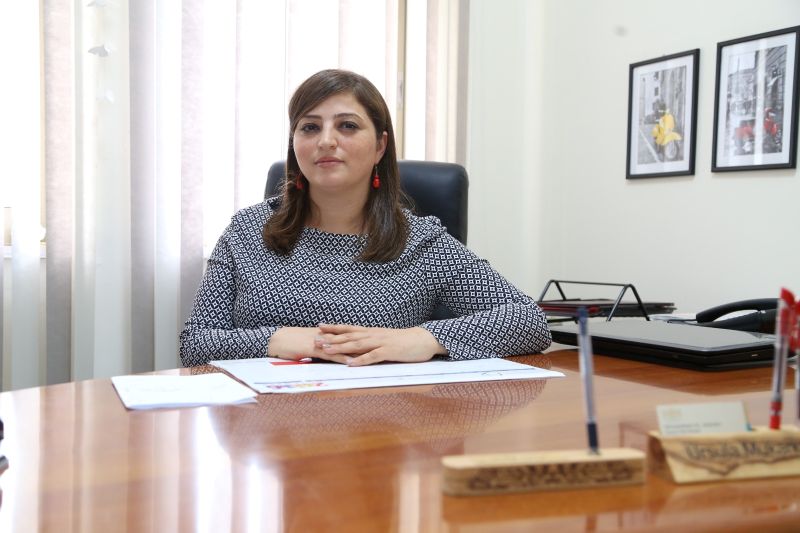
Ursula Mukarker is a psychologist and trauma therapist (zptn). Since 2011, she has led our partner organization, Wings of Hope for Trauma Care, in Bethlehem. In this interview, she explains how the ongoing threat affects people’s mental health and why trauma therapy poses particular challenges under these conditions.
When you look at the current situation in your city of Bethlehem: How is what people there are going through right now affecting their mental health and their daily lives?
When I look at the current situation in Bethlehem, it becomes clear that many people are still living with the consequences of their difficult experiences. Even if a dramatic event isn’t happening right in front of them every day, a constant sense of uncertainty persists. People worry about their families, their jobs, their financial situation, their freedom of movement, and what tomorrow will bring.
This has a very direct impact on daily life. People sleep worse, have trouble concentrating, get irritated more easily, or withdraw from others. Some lose their joy in things that used to be important to them. In children, this stress often shows up more in their behavior than in their words. And in many people, we sense, above all, a deep sense of exhaustion.
For me, the term “ongoing trauma” describes this situation very aptly, among other things. With a traumatic event that has come to an end, there is usually a clear distinction between “then” and “now.” Something terrible has happened, but at some point the immediate danger is over, and the person can begin to process what they’ve been through.
In the case of ongoing trauma—such as living under occupation and in a state of constant uncertainty for a long period of time—this separation is much more difficult. The external conditions do not change fundamentally, and the nervous system repeatedly receives signals that say, “I’m not really safe yet.” Even if nothing dramatic is happening at any given moment, the persistent uncertainty can keep people in a state of vigilance, tension, and inner alertness.
For this reason, reactions such as anxiety, sleep problems, irritability, or difficulty concentrating cannot always be interpreted as signs of a mental disorder. They may also be understandable reactions to a life situation in which threats and uncertainty persist.
That is why we must also be careful not to immediately view every reaction as a mental disorder. Under such circumstances, the symptoms mentioned may be understandable reactions to a genuinely uncertain life situation.
How can trauma therapy take place under conditions in which the stressful or traumatic situation persists? If the external conditions do not change and the threat continues, what can therapy actually achieve?
That is probably one of the most difficult questions we face in our therapeutic work.
If external conditions remain uncertain or threatening, therapy cannot provide a sense of safety that does not exist outside the therapy room. We cannot promise people that nothing bad will happen. And we cannot simply treat trauma as if it were exclusively a thing of the past when the person continues to live with uncertainty and fear. In situations of ongoing violence and insecurity, therapists cannot simply say, “You’re safe now.” Instead, they help people distinguish between what is currently a real danger and what may be the body’s reaction to ongoing stress. In doing so, they also acknowledge that insecurity is a part of everyday life for many people.
That’s why, at first, the focus isn’t always on intensive trauma processing, but rather on stabilization. We ask ourselves: What helps this person get through the day? What helps her regulate her nervous system? What resources do they have? Who can support them? How can they regain a small sense of control? How can they care for themselves and their children, sleep, breathe, connect with others, and carry on with their daily lives? That may sound simple, but under such conditions, it’s very important.
We’re also trying to help people regain a sense of agency. We can’t change the political or social situation, and we can’t simply make the uncertainty go away. But we can help people feel once again: “There are things I can influence. I can still make decisions. I’m not completely helpless.”
Traditional trauma therapy methods can still be very helpful. But we need to look very closely at when and for whom they are appropriate. Sometimes, trauma processing is possible. Sometimes it isn’t the right approach at that particular time. In those cases, the focus is on stabilization, grounding, social support, relationships, and practical coping strategies.
For me, therefore, therapy under such conditions means more than just coming to terms with the past. It also means helping people remain mentally vibrant, connected, and capable of taking action while they are living through a difficult present.
How does this situation affect you and the therapeutic team itself?
This is often forgotten when we talk about trauma: Therapists are people, too, and we live in the same environment. We don’t work from a safe distance. We live in the same society, hear the same news, have our own families, worries, and fears, and sometimes experience the same uncertainty as the people who come to us.
Of course, this also affects our team. We can feel tired, emotionally drained, or sometimes even numb inside. There are days when you listen to yet another very painful story and ask yourself, “How much more can people actually take?”
It can be particularly challenging when the stories we hear closely resemble our own experiences or past traumatic events. This can trigger personal feelings and memories in trauma therapists. At the same time, there is a risk of becoming so accustomed to difficult situations that one no longer even realizes how much they are affecting oneself.
That’s why self-care isn’t an extra task for therapists—nor is it a luxury. Supervision, mutual support, team discussions, and spaces where we can speak honestly about our own feelings are absolutely essential. We need to be able to say, “Today was hard for me, too.” That doesn’t make us any less professional. On the contrary, it helps us do our work responsibly over the long term.
What really helps us is the team itself. We support one another, share our experiences, laugh together sometimes, and remind ourselves that we can’t solve everything. We can support people, but we can’t carry the entire burden of a society’s suffering on our shoulders.
What would you like people who are looking at your situation from the outside to do? How can people support you?
I hope that people outside of Bethlehem will understand that Palestinians aren’t just statistics, numbers, or stories about conflict. They are parents who want to protect their children. Young people who want to study and build a future. People who want to work, love, laugh, celebrate, make plans, and simply lead normal lives.
When people develop mental health issues under such conditions, we shouldn’t just ask, “What’s wrong with this person?” We must also ask, “What has this person been through? And what are the conditions under which they have to live?”
I also hope people will understand that trauma care in a place like Bethlehem requires more than just therapeutic methods. It requires patience, flexibility, cultural understanding, and, above all, long-term support. We need more than just financial support for individual projects. We need sustainable support for local professionals, supervision and continuing education, safe spaces for children and adults, and opportunities for our teams to recharge.
We are convinced that sustainable psychosocial support must begin where people live and work, and that local professionals play a central role in this. We know our communities. We know the families, the culture, and the reality in which people live. International support is very valuable, but it is most effective when it strengthens—rather than replaces—local structures.
For me, hope means continuing to create spaces where people can feel like human beings—connected, seen, and empowered to take action—even when external conditions are very difficult.
Would you like to support the work of Ursula Mukarker and her team? If so, we appreciate any kind of help—whether through donations or simply by sharing their story.
The interview was conducted by Friederike Regel.


