


Bosnia and Herzegovina has been in a political crisis for years, weakening democratic institutions and straining social cohesion. National tensions, attacks on civil society and increasing insecurity for independent organizations are shaping the everyday lives of many people. Those who are committed to dialogue, peace and dealing with the trauma of war are particularly affected.
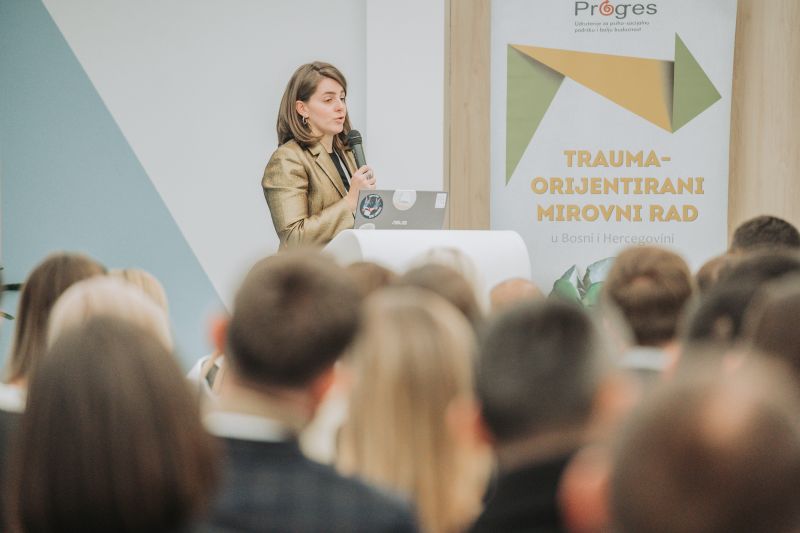
Azra Frlj is a psychologist, trauma counselor and head of our partner organization Progres in Bosnia and Herzegovina. A year ago, in an interview with us, she described the situation in the country as the most serious crisis since the Dayton Agreement. Twelve months later, little has changed in this assessment.
“Politically, there is hardly any movement. What has changed is the atmosphere in the country. It seems less tense, but characterized by a dangerous normalization,” says Azra Frlj. Many people have become accustomed to the permanent crisis or, as she puts it, have become “numb”.
This habituation to instability affects not only individuals, but civil society as a whole. Organizations continue to work, develop projects, look for solutions. But they are doing so under conditions that are increasingly demoralizing. The biggest challenge here is not a lack of will or expertise, but permanent uncertainty.
Working Under Conditions of Permanent Uncertainty
Political instability in the country is compounded by uncertain international funding: what used to be reliably promised is now often short-term, reduced, or completely discontinued. For many organizations, this uncertainty makes long-term planning difficult.
International donors are also increasingly focusing on short-term project funding. Six-month terms are no longer an exception. For Azra, this is not only inefficient, but also structurally harmful. “This tendency to only provide funding for six months is highly problematic,” she says. “This keeps organizations in a state of constant tension and at the same time demands measurable results within a very time. That is simply impossible.”
This logic is particularly problematic for trauma and peace building projects. Building trust, dialogue, and healing take time. Six months is hardly enough to build stable relationships in local communities, let alone achieve sustainable effects. Nevertheless, this funding practice forces many NGOs to constantly write new applications, to constantly reposition themselves and to fight for their own survival at the same time.
“In addition, larger organizations tend to benefit more from these funding structures,” says Azra Frlj. Organizations with fewer financial and human resources try to join forces and submit joint applications, but the competitive pressure remains high. In addition, many international funding programs are only designed for the short term or are faced with an extremely high number of applications. At the same time, the permissible administrative costs are often so low that reliable financing of personnel is hardly possible. “The majority of the funding is supposed to go directly into project activities,” explains Azra, “leaving very little scope for paying core staff.” This makes it increasingly unattractive for many organizations to submit applications at all.
Impact Despite Limited Resources
Despite these structural hurdles, Progres achieved visible success last year. Women with special protection needs received targeted support, including psychosocial counseling and violence prevention services. Peace and reconciliation work with young people is also being continued together with partner organizations. Progres also realized cultural and educational initiatives, including the production of a play that deals with discrimination against minorities. In addition, the team developed a support program for peace activists in response to the growing pressure faced by civil society actors on the ground.
At the same time, painful gaps remain. There is currently a lack of funding for the teacher training program. Talks with partner organizations are underway, but without reliable funding, much remains uncertain.
The burden is particularly evident on a personal level. Changes are imminent in the Progres office, a colleague is leaving the organization. New employees cannot be hired. This leaves Azra Frlj alone with the responsibility for ongoing projects. She says openly that she cannot carry this work alone in the long term. “What’s missing is not ideas or commitment, but stability. “What we need is planning security,” she explains. “A funding period of two years and the possibility of funding two permanent positions would fundamentally strengthen our work and its sustainability.”
What Is Needed Now
If you would like to support the work of Azra and her team, we welcome any form of solidarity. Your donations enable continuity in work that takes time and trust. Progres is also looking for long-term partnerships with international civil society organizations and companies that not only want to promote peace building, but also actively support it. Telling this story also helps to keep the space open for dialogue and reconciliation.
Friederike Regel


