


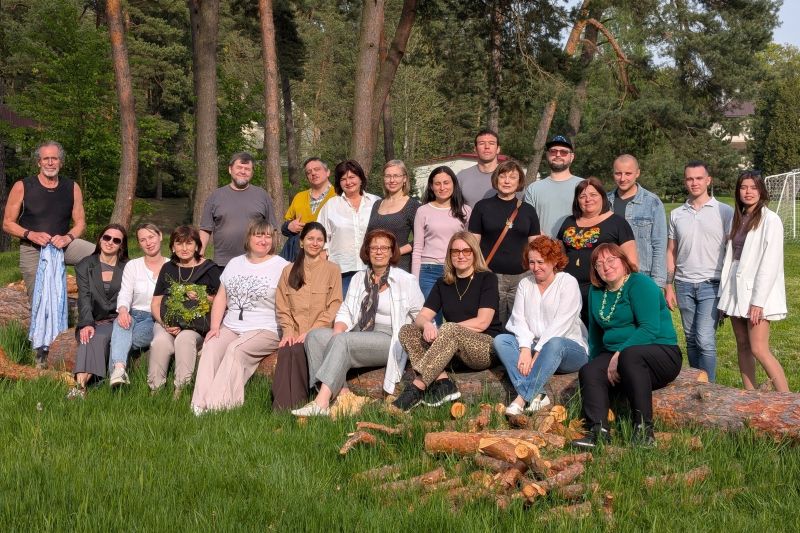
After two intensive years, our professional training in psychotraumatology in Ukraine is now culminating in 30 local professionals completing their training in December 2025. Together with our partner organization, the Kolping Society in Ukraine, we launched this professional training in November 2023 in response to the shortage of qualified trauma specialists. “After the war started, we had to learn quickly how to work with traumatized people. We barely had time to learn what that meant. We lacked knowledge and practical tools. The professional training was an opportunity to catch up.”
We can look back on eight intensive modules, most of which took place in presence in the western Ukrainian city of Lviv. The resource-oriented approach was a central element of the professional training, as the participants were confronted with insecure conditions in their day-to-day work due to attacks, air raids and power outages. In addition to the high level of commitment, a great deal of exhaustion was also noticeable, which had resulted from years of intensive work without a break – a topic that came up again and again. For many, the seminars also meant “a place to recharge their batteries and breathe a sigh of relief, allowing them to switch from survival mode to life mode”.
Group and Self-Awareness as a Resource
Organizing a training course under wartime conditions meant dealing with a special reality: The participants accompany traumatized people in their work on a daily basis and at the same time carry their own war experiences with them: losses, existential fears, separations, the constant worry about relatives at the front or children who had to leave the country. In the context of collective traumatization, the oscillation between professional role and self-awareness, between stress and resources, became a central element of the training. This also strengthened the group feeling. One participant said: “I have changed and that is thanks to the group. I have reconsidered the principles of my work: how important it is not only to apply the techniques, but also to involve the bond, the thoughts, the emotions and the body.”
What Happens Next
In the last module, one participant said that she had the feeling that she was “only now in the middle of the process and not at the end”. Addressing the group, she said: “Please stay in my life. Let’s grow together”. To enable the group to stay in contact, we will be offering monthly online supervision in the coming year. We are also in talks with donors who have promised us and our partners funding for a second round of training.
Similar to the conclusion of the last professional training in Central America, everyone in Ukraine agreed that the real work only begins now or after the end of the war: “It is not enough to end the war. It is important to organize peace. In the same way, it is not enough to deal with the trauma. It is also important to find your way back to life.”
Julia Borchardt (Project Coordination Ukraine)


