


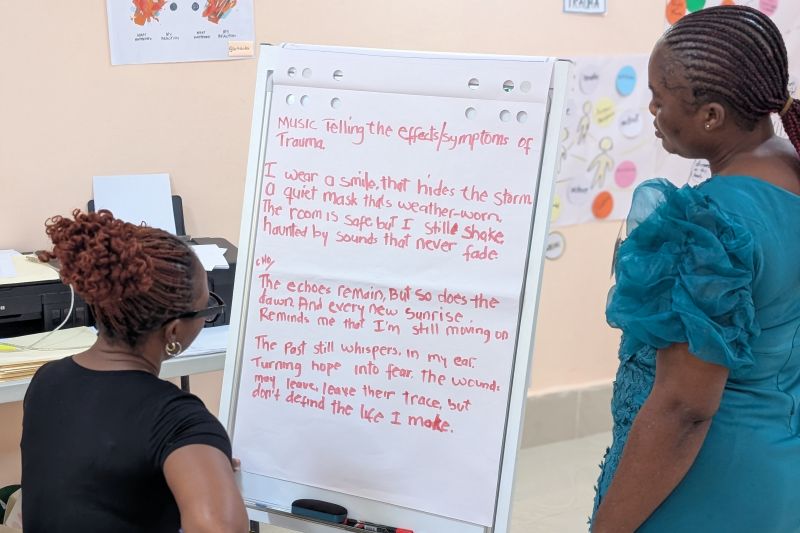
How can people regain a sense of security and find new hope after traumatic experiences? Twenty-one participants from Liberia explored this question during a ten-day seminar on psychotraumatology. “We don’t just treat symptoms; we restore hope. The seminar is an opportunity to become an instrument of God’s love and compassion,” said Arthur, one of the participants, during the morning devotional led by the group.
From June 28 to July 8, 2026, we conducted the seminar “Stabilization and Resource-Oriented Work: An Introduction to psychotraumatology” in partnership with the “Trauma Healing and Reconciliation Program” of the Lutheran Church of Liberia. Together, we worked to understand the consequences that trauma and violence can have for individuals and for society, and how to explain to those affected what is causing their difficulties.
Trauma Care That Builds Connections
To this day, Liberia remains marked by the aftermath of the civil war, which left deep wounds in many communities. Mistrust, broken social ties, and unresolved traumatic experiences continue to have an impact to this day. For over 20 years, the Lutheran Church of Liberia has made trauma healing its mission. “Traumatic experiences can separate people and communities from one another. Our work helps rebuild those connections,” says Philip Nushann Jr., the director of trauma care.
This idea shapes the team’s work: It organizes local dialogue processes that bring together as many different stakeholders from a community as possible. Together, we identify problems and develop solutions to rebuild trust and social cohesion.
In addition, the team provides support to people in socially disadvantaged areas and in prisons. A particular challenge in Liberia at present is the rise in drug use, especially among young men. The team therefore focuses on the rehabilitation of drug addicts with the goal of reintegrating them into the community.
Finding Stability and Strengthening Resources
The seminar also focused on sharing knowledge and developing new approaches to working with traumatized individuals. The participants learned about psychoeducation methods and created their own songs, stories, and short plays to share this knowledge in their respective contexts.
The seminar focused on stabilization methods. These included, among other things, visualization exercises to develop positive inner images, as well as drawing on empowering life experiences and the positive self-image associated with them. The participants first tried out all the methods for themselves and then reflected on how they could apply them in their work with traumatized people.
“Just the fact that I tell myself, ‘I am beautiful, strong, and loved,’ changes the way I see myself,” said one participant after an exercise involving empowering thoughts.
Many participants also shared their own difficult life stories. “I grew up in poverty and without parents. There was no safe place for me. Now I’ve built a life of my own. The image of my tree, which I created during the visualization exercise, gives me a sense of security and comfort.”
Community as a Source of Security
Recognizing that self-care and a sense of community are important factors in trauma care, we organized a group outing to a nature resort to create a positive life experience. Through personal interaction and practicing together, the bonds among them were also strengthened.
“I hope that we will continue to be there for one another in the future and create an atmosphere of safety in which everyone feels included,” said one participant during the closing session.
We are taking many inspiring impressions and experiences from Liberia back with us to use in our work. In particular, we still have a lot to learn from looking at the connections within the community. We will continue to pursue the idea of inviting Philip Nushann to Germany to speak at a seminar.
Julia Borchardt, Project Coordinator for Ukraine, and Martina Bock, CEO and Manager of international projects


