


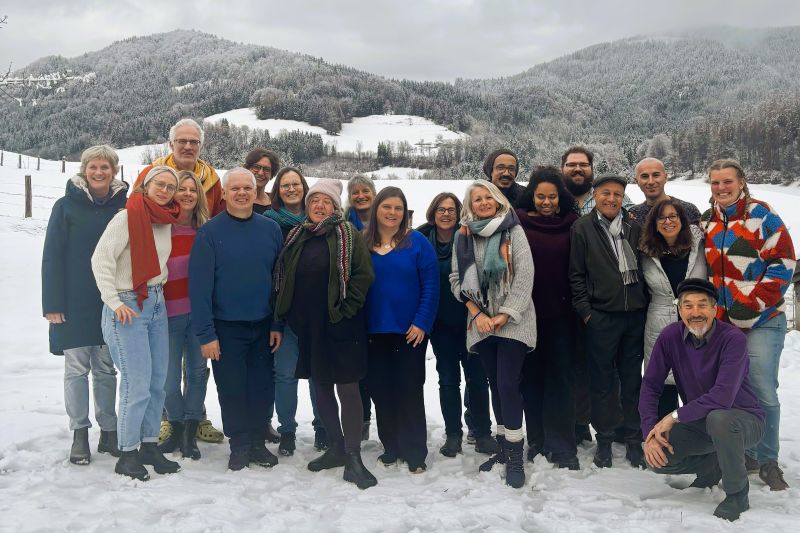
From November 23 to 25, 2025, we hosted a three-day seminar on Collective Resilience and the paradigm of Integrative Community Therapy (IGT) at Labenbachhof. A total of 19 members of our network of trauma specialists took part.
The event was part of our annual free training program for members of our network of trauma specialists. The seminar series is part of our project to stabilize people with a history of displacement, which has been funded by the EU since 2024.
The seminar was led by our colleague Mariano Pedroza, with whom we have worked together for many years. Mariano is a trauma therapist and combines physical and systemic approaches in his work. He lives and works in Brazil and has a particular focus on collective resilience.
Integrative Community Therapy as a Paradigm Shift
During this seminar, we were able to explore IGT not only as a therapeutic method, but as a paradigm shift in our understanding of healing and resilience. Instead of viewing individual problems in isolation, it focuses on the community and its resources.
Based on systemic thinking, sensitivity to other cultures, and collective self-empowerment, IGT opens up opportunities to work together effectively. Complementing our experience in trauma care, it can help to promote collective resilience and create spaces where communities can heal, connect and thrive together.
Learning Through Experience: Body, Music and Community
In addition to interesting theoretical input, we did a lot of practical exercises, in line with the principle of “learning by doing.” The “perfect alternation between theory and participative practical exercises” was particularly appreciated.
As our seminar leader is trained in the body-oriented therapy methods Tension and Trauma Releasing Exercises (TRE) and Somatic Experiencing, we worked intensively with the body and tried out physical exercises together. In integrative community therapy, music is also used to promote emotional expression and social bonding in the group. That’s why we sang together and made music with the instruments brought by the participants. “I was particularly impressed by the power of the group and the ‘live’ experience of the applicability of the methods,” said one participant.
The seminar was very enriching and fulfilling. It took place in a wonderful, collegial, appreciative and invigorating atmosphere. One participant summed it up as follows: “It was a very enriching experience with a high degree of experiential and self-awareness. I am grateful for that.”
We are enthusiastic about the possibilities of the method and want to integrate it firmly into our program. From 2027, we plan to offer professional training in which interested parties can experience Integrative Community Therapy for themselves and apply it in practice.
Lucija Lukić Holjan


